 Nordcite
How to get cited in Google's AI Overviews: what the evidence says in 2026
September 18, 2026NordciteLast reviewed September 18, 2026
Google says there is no special trick, and the best evidence mostly agrees. Here is what gets a brand named and cited in AI Overviews and AI Mode, in five steps, each labeled by the evidence behind it: what Google says, controlled tests, correlation studies and what we saw in 50 dated captures.
Last reviewed September 18, 2026.
The short answer
Be eligible. A page can be cited only if Google can index it and show a snippet from it, and nothing in robots.txt, your CDN or Search Console's new AI opt-out keeps it out. [Google says]
Rank for the sub-questions, not only the head term. Google grounds AI answers in its core ranking systems and adds related "fan-out" searches. In Ahrefs' March 2026 study, 37.9% of URLs cited in AI Overviews also appeared within the first 10 result blocks for the query. [Google says; correlation study]
Be the best source for questions about you. On September 7, 2026, notion.com was cited in AI Overviews about Notion's refunds, pricing, support and uptime, and in none of 25 best-of and alternatives answers. [seen in our captures]
Earn a place, the honest way, in the sources Google already cites for your category. In the same 50 answers, YouTube was cited in 36 and Reddit in 17, and 83 of the 110 cited domains appeared only once. [seen in our captures]
Skip the hacks. Google says Search ignores llms.txt and needs no special schema, a controlled test found no citation gain from adding schema, and Google's spam policy now covers attempts to manipulate AI answers. [Google says; controlled test]
Named or cited: know which one you're after
You want both, and they are different. Named means your brand appears in the answer's text. Cited means a page from your own site is one of the answer's linked sources.
The gap can be wide. On September 7, 2026, between 09:47 and 10:07 UTC, we captured 50 Google searches about Notion and its category from the United States, signed out, one capture per query: 15 best-of, 15 comparison, 10 alternatives and 10 trust queries. Notion did not commission this and has no relationship with Nordcite; we chose it because everyone knows it.
All 50 searches showed an AI Overview. Notion was named in 42 of them. A Notion-owned page was cited in 7 (notion.com in 6, notion.so in 1), so most of what those answers said about Notion came from other people's pages.
Being named is what a buyer reads. Being cited earns the link, counts in Search Console and lets you state your own facts. Record both, per query. The full data is in our study of 50 AI Overviews about Notion.
How do AI Overviews choose their sources?
According to Google, through its core ranking systems, widened by related searches the model runs itself. Ranking still matters, but for more queries than the one the user typed.
Google's guide to generative AI features describes grounding as "relying on our core Search ranking systems to retrieve relevant, up-to-date web pages from our Search index." It describes query fan-out as "concurrent, related queries generated by the model to request more information and fetch additional relevant search results to address the user's query." In Google's example, "how to fix a lawn that's full of weeds" might fan out to "best herbicides for lawns", "remove weeds without chemicals" and "how to prevent weeds in lawn".
That is why studies of the "top 10" seem to disagree. Most research in this field comes from companies that sell SEO software; we cite each study with its sample and date.
Do you need to rank in the top 10? Four numbers, reconciled
Study (date, sample) What it counts Result Ahrefs, Jul 21, 2025 (1.9M citations from 1M AI Overviews) Only the first three visible citations in each AI Overview 76% ranked in the top 10 Ahrefs, Mar 2, 2026 (863K keyword SERPs, 4M cited URLs) Every cited URL, against the first 10 result blocks of any type 37.9% appeared in the first 10 blocks SE Ranking, Feb 26, 2026 (100K US keywords) AI Overview sources in the side panel (inline links excluded) 19% overlapped with the top 10 seoClarity, Oct 2025 (362K US desktop queries) Whole AI Overviews, not single citations 90% cited at least one top-10 page The first three rows ask what share of cited pages rank in the top 10. The last asks what share of answers include at least one top-10 page. Read together: most AI Overviews still cite something from the top 10, but most individual citations come from pages that don't rank there for the query typed. The two Ahrefs studies are not a clean before-and-after either: Ahrefs says it improved its parsing in between, and it links the lower share to AI Overviews' move to Gemini 3 in January 2026 and to fan-out.
What to do: for each main query, list the questions buyers ask next (price, alternatives, "X vs Y", "is it safe") and check that a page of yours ranks for each. Don't build a page for every variation; see what doesn't help.
Step 1: Make sure Google can use your pages
Evidence: Google says
If Google can't index a page or show a snippet from it, the page can't be cited. Check this first; it is the cheapest fix.
Google's documentation is explicit: "To be eligible to be shown as a supporting link in AI Overviews or AI Mode, a page must be indexed and eligible to be shown in Google Search with a snippet, fulfilling the Search technical requirements." It adds: "There are no additional requirements to appear in AI Overviews or AI Mode, nor other special optimizations necessary."
| Check | Why |
|---|---|
| robots.txt and your CDN or host let Googlebot in | Google's list starts with "Ensuring that crawling is allowed in robots.txt, and by any CDN or hosting infrastructure". Since Sep 15, 2026, Cloudflare's "Block" and "Block on pages with ads" settings also apply to Googlebot, so either one affects search as well as AI training. Its "Disallow AI Training" setting keeps search crawlers allowed. |
No stray nosnippet, max-snippet or noindex | Per Google, nosnippet also stops content from being used "as a direct input for AI Overviews and AI Mode", and max-snippet limits how much can be used. |
| Search Console's "Search generative AI control" is off, unless you chose it | Open to all sites since Aug 31, 2026, it removes your pages from AI Overviews, AI Mode and Discover's AI features. Google: "You won't receive any traffic or impressions from these features." |
| Key facts are in the page text | Google asks for "Making sure that important content is available in textual form". Put prices, plan names and policies in text, not only in images. |
| Key facts are in the HTML, not added later by JavaScript | This matters most outside Google. In Vercel's Dec 2024 analysis, crawlers from OpenAI, Anthropic, Meta, ByteDance and Perplexity did not run JavaScript; Google's Gemini (through Googlebot) and Apple's crawler did. |
One setting people mix up: blocking Google-Extended is not the AI Overviews switch. It covers Gemini training and grounding in the Gemini app and Vertex AI, and Google says it "does not impact a site's inclusion in Google Search". More on the new control: Search Console's generative AI report, explained.
Step 2: Be the best source for questions about you
Evidence: seen in our captures
In our captures, Notion's own site answered questions about Notion's own prices and policies. On the questions buyers ask while choosing a tool, other people's pages answered.
On September 7, 2026, notion.com was cited in the AI Overviews for "Notion refund policy" (exhibit 46, where all four sources were notion.com), "can you get your money back from Notion" (41, all three sources), "Notion pricing plans 2026" (45, as the first source), "Notion customer support reviews" (44), "Notion reliability and uptime" (47) and one comparison, "Notion vs Confluence" (27). A notion.so page was cited once more, for "Notion vs ClickUp" (26).
In the 25 best-of and alternatives queries, no Notion-owned page was cited, although Notion was named in 21 of those answers. Two other answers show who fills the gap:
- "is Notion safe and secure" (exhibit 43). In the default view we captured, before "Show more", the sources were two Reddit threads and a YouTube video, and no Notion page. The answer opened: "Notion is secure enough for general business and personal productivity, but it is not end-to-end encrypted, meaning Notion holds the keys and can technically read your data."
- "Notion vs ClickUp pricing" (exhibit 50). The answer opened: "ClickUp is consistently 30% to 40% cheaper than Notion at equivalent paid tiers, though their core strengths split between project operations and documentation." Its three sources were comparison posts on rock.so (the site of Rock, a smaller team-chat and project-management app) and zenpilot.com, and a ClickUp help-center page comparing the two products. No Notion page was cited.
Across the 50 answers, ClickUp-owned pages were cited in 7, and rock.so in 10, all of them Notion comparison, alternatives or pricing queries.
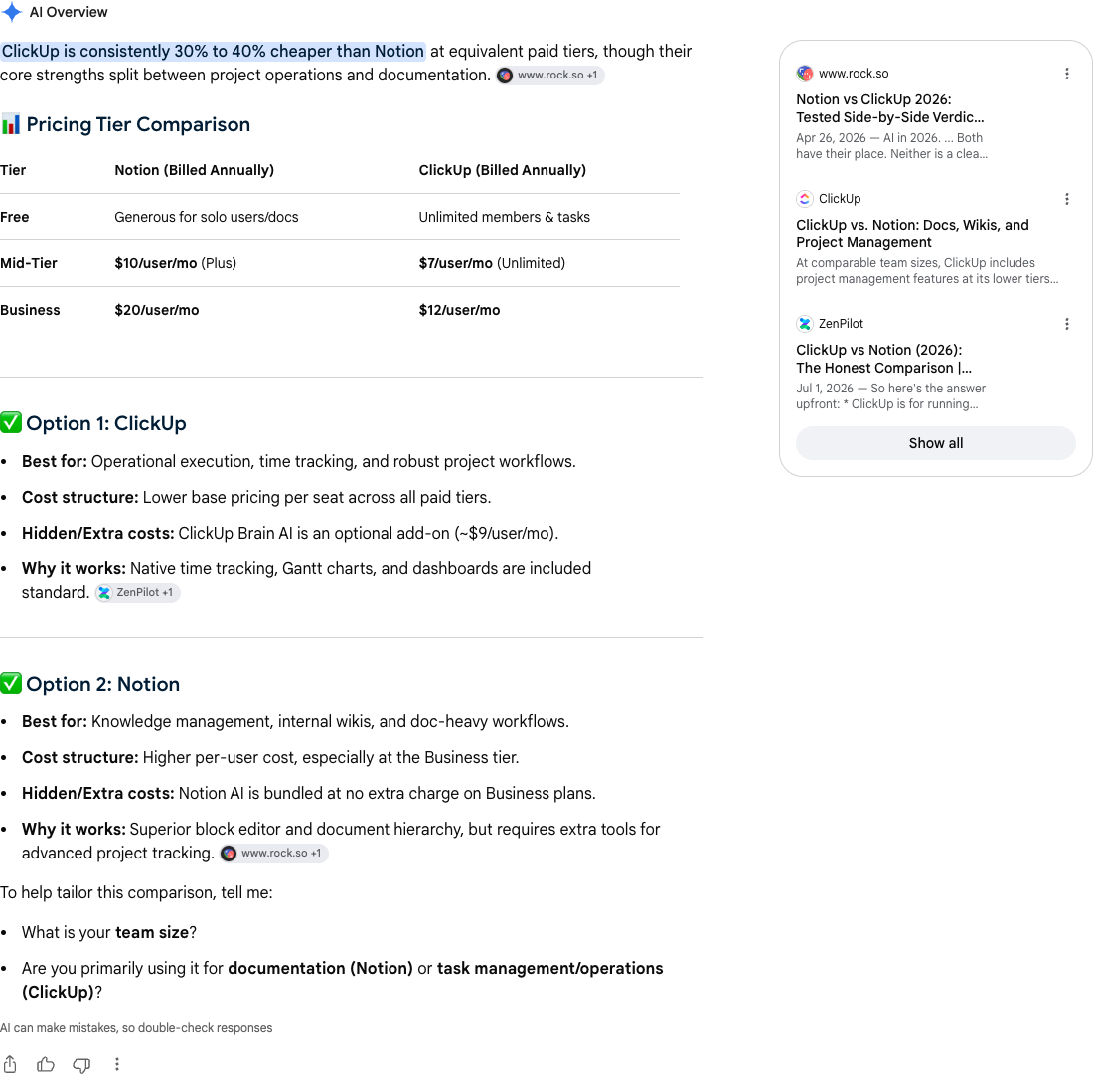
Exhibit 50. Google AI Overview for "Notion vs ClickUp pricing", United States, signed out, captured September 7, 2026, 10:06 UTC.
What to do:
- List what people ask about you: price, refunds, cancellation, security, uptime, support, "you vs [competitor]", "[you] alternatives".
- Give each question a page that answers it in the first lines, in plain text, with numbers and a date. Keep those pages current.
- Publish comparison pages for the products people actually compare you with, and say where the other product is the better fit. Be careful with self-promotional "best X" lists that rank you first. In February 2026, SEO consultant Lily Ray documented visibility drops of 29% to 49% at SaaS and B2B sites that had published many such lists, some of them hundreds, and quoted Glenn Gabe observing that sites losing ground were also dropping in AI Overviews.
Step 3: Get into the sources Google already cites for your category
Evidence: seen in our captures · correlation study · Google says
In our Notion captures, most of the cited pages were not Notion's. Find out which sites Google cites for your queries, then earn a place in them without faking it.
Google's guide says real mentions count: "Just like the rest of Google Search, our generative AI features can show what's being said about products and services across the web, including in blogs, videos, and forum discussions." It adds that "seeking inauthentic 'mentions' across the web isn't as helpful as it might seem."
Our 50 Notion answers cited 110 different domains. YouTube appeared in 36 answers, Reddit in 17, zapier.com in 11 and rock.so in 10. Many cited sites were small and specific, such as taskrhino.ca and zenpilot.com (5 answers each), and 83 of the 110 domains appeared in only one answer. It is one category on one morning, but it suggests the sources that shape a category can be listed, and many can be reached.
Ahrefs' study of 75,000 brands (May 2025, updated April 2026) found that branded web mentions correlated with visibility in AI Overviews at 0.664, against 0.218 for backlinks. Its December 2025 follow-up found YouTube mentions correlated more strongly still (see step 5). Correlation is not causation: well-known brands have more of everything.
What to do:
- Build a citation inventory. Take 30 to 50 queries your buyers type (best-of, alternatives, comparisons, trust questions), search each one signed out, and list every cited domain. Count the answers each domain appears in and group them: video, forums, review sites, publishers, competitors, niche blogs. Keep a separate list for each country you sell in: in a 12-country study of six software categories (April 2026), Temso AI found that two countries shared on average 7.9% of the domains cited in Google AI Overviews, or 19.0% when they shared a language.
- Take the honest route into each type. Video: your own channel, plus creator reviews declared as paid promotion when you pay for them, as YouTube requires. Reddit and forums: answer real questions from accounts that say who you are. Review sites: invite every customer, not only happy ones. Comparison sites: send accurate facts and corrections, and never pay for a placement dressed up as editorial.
- Don't fake it. No sock-puppet accounts, seeded posts or undisclosed sponsorships. Since May 2026, Google's spam policy has included "attempting to manipulate generative AI responses in Google Search" (Search Engine Land reported the change on May 15, 2026).
The earned-media playbook covers each source type and the rules that apply to it.
Step 4: Publish things worth citing
Evidence: Google says · controlled test
Give Google, and the people it cites, something they can't get elsewhere: your own data, specific numbers, direct answers.
Google's guide ranks this above its other advice: "Creating content that people find unique, compelling, and useful will likely influence your website's presence in generative AI search in the long run more than any of the other suggestions in this guide." It contrasts commodity content, "often based on common knowledge, which could originate from anyone", with non-commodity content that "provides unique expert or experienced takes that go beyond common knowledge and the ordinary."
Academic tests of rewriting pages for AI answers are mixed. A 2024 study (Aggarwal and colleagues, KDD 2024) found that adding quotations, statistics and citations raised how much of a test engine's answers drew on a source; the best methods beat the baseline "by 41% and 28%" on its two measures. Those figures come from an engine the authors built (GPT-3.5 answering from the top five Google results); they also tried the methods on Perplexity.ai, but not on Google AI Overviews. A 2025 benchmark, C-SEO Bench, found that "most current C-SEO methods are not only largely ineffective but also frequently have a negative impact on document ranking." We go through both in does llms.txt work?
What to do: publish data you can stand behind, such as benchmarks, surveys or anonymized product statistics. Put the key number and its date in the first lines, show your method, cite your sources and name the expert. Facts like these also travel: when writers, creators and forum posters quote your numbers, you get named in the pages Google already cites.
Step 5: Answer the same questions on video
Evidence: seen in our captures · correlation study
YouTube was the most-cited domain in our captures, and in Ahrefs' September 2026 US data for AI Overviews. If your buyers watch videos before they choose, some of those videos should be yours or mention you.
- On September 7, 2026, youtube.com was cited in 36 of our 50 Notion answers: 14 of 15 best-of, 12 of 15 comparison, 5 of 10 alternatives and 5 of 10 trust queries. It was the first-listed source in 7.
- In Ahrefs' analysis of more than 3 million US queries (published June 1, 2026, updated September 2, 2026), YouTube accounted for 22.9% of AI Overview citations among the 50 most-cited domains, and Reddit for 18.5%. That is a share of those 50 domains' citations, not a count of answers like ours, but it points the same way.
- In Ahrefs' December 2025 study of 75,000 brands, YouTube mentions had the strongest correlation with AI visibility of any factor measured, about 0.737, across ChatGPT, AI Mode and AI Overviews. As Ahrefs puts it, "correlation isn't causation."
What to do: make short, specific videos that answer the step 2 questions (pricing explained, setup, you vs a named competitor), titled the way people search. Work with creators who already review your category, and if you pay them, make sure the video is declared as paid promotion.
What doesn't help
Evidence: Google says · controlled test
Google says the popular "AI hacks" do nothing for Search, and a controlled test of schema agrees.
- llms.txt. Per Google's guide, creating one "will neither harm nor help your site's visibility or rankings in Google Search, as Google Search ignores them."
- Special schema. "Structured data isn't required for generative AI search, and there's no special schema.org markup you need to add." In Ahrefs' test (May 11, 2026), 1,885 pages that added JSON-LD were compared with 4,000 similar pages that didn't. Over the next 30 days their AI Overview citations fell 4.6% relative to the comparison pages, a small but statistically significant drop. The pages were already heavily cited.
- Chopping pages into chunks. "There's no requirement to break your content into tiny pieces for AI to better understand it."
- A page for every fan-out query. Doing that "primarily to manipulate rankings or generative AI responses in Google Search violates Google's scaled content abuse spam policy."
- Fake or bought mentions. See step 3.
For every common myth, checked against Google's guide, see does llms.txt work?
How to tell if it's working
Use two instruments: Search Console for the links Google showed, and a fixed set of queries captured on a schedule for what the answers said.
Search Console's generative AI performance report, open to all sites since August 31, 2026, counts impressions: "Impressions are how many times links to your site were shown to a user in a generative AI feature on Google Search." You can split them by page, country, device and date. There are no queries or clicks, and because the report counts links, a brand named without a link doesn't appear.
The answers themselves move. In Ahrefs' tracking of more than 43,000 keywords, each observed at least 16 times over about a month (published November 11, 2025), "AI Overviews have a 70% chance of changing from one observation to the next." Between consecutive versions, 45.5% of cited sources were new, while the meaning stayed almost the same.
So keep the same queries per market, capture each answer with its date, and record whether an AI Overview appeared, whether you were named or cited, who else was named and which sources were listed, in order. Report counts with their denominators ("named in 42 of 50 on September 7, 2026"), and claim a change only with a dated before and after, ideally more than one capture of each. That per-query record, with a screenshot of every answer, is what our report contains.
More on both: how to report AI visibility to clients and what the Search Console AI report shows.
AI Mode and ChatGPT: what's different
The groundwork is the same, but the sources differ, so check each surface separately.
AI Mode. Google says AI Mode "is particularly helpful for queries where further exploration, reasoning, or complex comparisons are needed." In Ahrefs' comparison of 540,000 US query pairs from September 2025, "AI Mode and AI Overviews cited the same URLs only 13.7% of the time," although the answers said much the same thing.
In BrightEdge's tracked US consumer-product and finance queries, google.com made up 44.9% of AI Mode citations in August 2026, against 9.9% of AI Overview citations, so keep your Merchant Center and Business Profile information current. Since January 2026, people can ask a follow-up from an AI Overview and continue in AI Mode, first on mobile and, by May 2026, on desktop too, per Google.
ChatGPT. A separate system with its own crawlers. OpenAI: "Sites that are opted out of OAI-SearchBot will not be shown in ChatGPT search answers, though can still appear as navigational links." GPTBot, its training crawler, is a separate setting, so blocking GPTBot does not remove you from ChatGPT search. As step 1 notes, content that appears only after JavaScript runs may be invisible to it.
What we don't know yet
- Whether any of this causes citations. Most of the evidence is correlation. The controlled tests we have found no gain from adding schema, and lab gains from rewriting that a broader 2025 benchmark mostly did not find.
- Which model runs AI Overviews now. Google made Gemini 3 the default model for AI Overviews in January 2026 and named Gemini 3.5 Flash as AI Mode's default in May 2026, but hasn't said whether AI Overviews moved to 3.5 Flash. Studies from before 2026 may describe an older system.
- Independent replication. We found no study from outside the SEO software industry that repeats the 2026 top-10 figures.
- Other markets. Most studies are US and English-language. We found no 2026 study that reports UK AI Overview sources on their own; Temso's 12-country study includes the UK but publishes only cross-country averages.
- Signed-in answers and timing. Signed-out captures, ours included, show one context; personalized answers may cite different sources. And no study we trust measures how long it takes from publishing a page to being cited.
- Better data from Google. Google told Search Engine Land on June 3, 2026 that it will "introduce additional metrics over time" in Search Console.
FAQ
Do you need to rank in the top 10 to be cited in AI Overviews?
No, but ranking helps. In Ahrefs' March 2026 study, 37.9% of cited URLs appeared in the first 10 result blocks and 31.0% came from beyond the top 100 blocks; Ahrefs links this to fan-out searches for related sub-questions. Per answer, seoClarity found in October 2025 that 90% of AI Overviews cited at least one top-10 page.
Why is my website not in AI Overviews?
Usually one of five reasons. The query may not show an AI Overview at all: in Seer Interactive's data from 53 client accounts (February 2026), informational comparison ("X vs Y") queries showed one 95.4% of the time and single-word informational queries 27.3%. Otherwise, your pages may be blocked or snippet-restricted (step 1), you may not rank for the sub-questions (step 2), other sites may answer better (step 3), or the answer changed since you last checked.
How do I get my brand named in AI Overviews, not just linked?
Be discussed on the pages Google cites for your category. Notion was named in 42 of our 50 answers on September 7, 2026, but Notion-owned pages were cited in only 7; the sources included YouTube videos, Reddit threads, comparison blogs and competitors' pages. That is why steps 3 and 5 matter as much as your own site.
Does being cited in an AI Overview bring clicks?
Some. In Seer Interactive's data from 53 client accounts (published April 24, 2026), informational queries where the brand was cited in the AI Overview had a 2.07% organic click-through rate, against 0.94% when it wasn't cited and 3.35% when no AI Overview showed. Seer notes that one account makes up 47% of the not-cited impressions and pulls that figure down. It is an observed comparison, not a controlled test.
Is this GEO or AEO?
Some call it GEO or AEO; Google's own guide calls it SEO: "From Google Search's perspective, optimizing for generative AI search is optimizing for the search experience, and thus still SEO."
Sources
- Google Search Central, "Optimizing your website for generative AI features on Google Search", published May 15, 2026, updated July 10, 2026, https://developers.google.com/search/docs/fundamentals/ai-optimization-guide
- Ahrefs (Louise Linehan), "76% of AI Overview Citations Pull From the Top 10", July 21, 2025, https://ahrefs.com/blog/search-rankings-ai-citations
- Ahrefs (Louise Linehan), "Update: 38% of AI Overview Citations Pull From The Top 10", March 2, 2026, https://ahrefs.com/blog/ai-overview-citations-top-10/
- SE Ranking (Yulia Deda), "Gemini 3 impact on AI Overviews: Nearly half of cited domains changed, 32% more sources per answer, and sourceless bug fixed", February 26, 2026, https://seranking.com/blog/gemini-3-impact-on-ai-overviews/
- seoClarity (Mitul Gandhi), "The Overlap Between AI Overviews and Organic Rankings", updated October 2025, https://www.seoclarity.net/research/aio-rankings-overlap
- Google Search Central, "AI features and your website", updated December 10, 2025, https://developers.google.com/search/docs/appearance/ai-features
- Cloudflare (Bryan Becker), "Have it both ways: stay discoverable in search while disallowing AI training", September 15, 2026, https://blog.cloudflare.com/accountable-mixed-use-ai-crawlers/
- Google Search Central, "Robots meta tag, data-nosnippet, and X-Robots-Tag specifications", updated March 24, 2026, https://developers.google.com/search/docs/crawling-indexing/robots-meta-tag
- Google Search Console Help, "Search generative AI control", accessed September 18, 2026, https://support.google.com/webmasters/answer/16908024
- Vercel (Giacomo Zecchini, Alice Alexandra Moore, Malte Ubl, Ryan Siddle), "The rise of the AI crawler", December 17, 2024, https://vercel.com/blog/the-rise-of-the-ai-crawler
- Google Search Central, "List of Google's common crawlers", updated July 14, 2026, https://developers.google.com/crawling/docs/crawlers-fetchers/google-common-crawlers
- Lily Ray, "Is Google Finally Cracking Down on Self-Promotional Listicles?", February 3, 2026, https://lilyraynyc.substack.com/p/is-google-finally-cracking-down-on
- Ahrefs (Louise Linehan), "An Analysis of AI Overview Brand Visibility Factors (75K Brands Studied)", May 26, 2025, updated April 27, 2026, https://ahrefs.com/blog/ai-overview-brand-correlation/
- Temso (David Gregorian), "Your SaaS Authority Ends at the Border: How AI Citations Change by Country", updated April 13, 2026, https://www.temso.ai/data/Your-SaaS-authority-ends-at-the-border
- YouTube Help, "Add branded content restrictions & disclosure labels", accessed September 18, 2026, https://support.google.com/youtube/answer/154235
- Google Search Central, "Spam policies for Google web search", updated August 28, 2026, https://developers.google.com/search/docs/essentials/spam-policies
- Search Engine Land (Barry Schwartz), "Google confirms spam policies apply to AI Overviews and AI Mode", May 15, 2026, https://searchengineland.com/google-updates-search-spam-policies-to-clarify-it-applies-to-generative-ai-responses-477657
- Pranjal Aggarwal, Vishvak Murahari, Tanmay Rajpurohit, Ashwin Kalyan, Karthik Narasimhan, Ameet Deshpande, "GEO: Generative Engine Optimization", KDD 2024 (arXiv version 3, June 28, 2024), https://arxiv.org/abs/2311.09735
- Haritz Puerto, Martin Gubri, Tommaso Green, Seong Joon Oh, Sangdoo Yun, "C-SEO Bench: Does Conversational SEO Work?", arXiv, June 6, 2025, revised October 20, 2025, https://arxiv.org/abs/2506.11097
- Ahrefs (Si Quan Ong), "The 50 Most-Cited Websites in Google AI Overviews (September 2026)", June 1, 2026, updated September 2, 2026, https://ahrefs.com/blog/most-cited-domains-ai-overviews/
- Ahrefs (Louise Linehan), "Top Brand Visibility Factors in ChatGPT, AI Mode, and AI Overviews (75k Brands Studied)", December 12, 2025, https://ahrefs.com/blog/ai-brand-visibility-correlations
- Ahrefs (Louise Linehan), "We Tracked 1,885 Pages Adding Schema. AI Citations Barely Moved.", May 11, 2026, https://ahrefs.com/blog/schema-ai-citations/
- Google Search Console Help, "Generative AI performance report (Search)", accessed September 18, 2026, https://support.google.com/webmasters/answer/16984139
- Ahrefs (Louise Linehan, Xibeijia Guan), "AI Overviews Change Every 2 Days (But Never Change Their Mind)", November 11, 2025, https://ahrefs.com/blog/ai-overview-change/
- Ahrefs (Despina Gavoyannis), "Are AI Mode and AI Overviews Just Different Versions of the Same Answer? (730K Responses Studied)", December 15, 2025, https://ahrefs.com/blog/ai-overviews-vs-ai-mode/
- BrightEdge, "Google AI Mode Cites Itself 4.5x More Than AI Overviews. Your Brand Can Still Be Winning.", September 7, 2026, https://www.brightedge.com/resources/weekly-ai-search-insights/google-ai-mode-cites-itself-rich-results
- Google (Elizabeth Reid), "A new era for AI Search", May 19, 2026, https://blog.google/products-and-platforms/products/search/search-io-2026/
- Google (Robby Stein), "Just ask anything: a seamless new Search experience", January 27, 2026, https://blog.google/products-and-platforms/products/search/ai-mode-ai-overviews-updates/
- OpenAI, "Overview of OpenAI Crawlers", accessed September 18, 2026, https://developers.openai.com/api/docs/bots
- Search Engine Land (Barry Schwartz), "Google Search Console AI performance reports and controls to block your content in AI responses", June 3, 2026, https://searchengineland.com/google-search-console-ai-performance-reports-and-controls-to-block-your-content-in-ai-responses-479298
- Seer Interactive (Tracy McDonald, Hannah Cooley, Marketa Williams), "AIO Impact on Google CTR: 2026 Update", April 24, 2026, https://www.seerinteractive.com/insights/aio-impact-on-google-ctr-2026-update
Nordcite's own figures come from 50 Google AI Overviews about Notion, captured from the United States, signed out, on September 7, 2026. Every exhibit is in our Notion study.
See what Google's AI Overview says about your brand, in the country you sell in. Nordcite's AI Visibility Report runs a query set written for your brand in the markets you choose and photographs every AI Overview: who is named, which sources are cited, dated. A person approves your queries before anything runs and reads the report before it ships. Each report is scoped and quoted for the brand it describes. See a sample report · Ask for a quote
Read next
- We photographed 50 Google AI Overviews about Notion. Here's who got cited.
50 Google AI Overviews about Notion, captured in the US on Sep 7, 2026: YouTube cited in 36, Reddit in 17, notion.com in 6. 110 domains, 83 cited once.
- Earned media for AI citations: how to get into the sources Google already cites (without astroturfing)
In 50 AI Overviews about Notion (Sep 7, 2026), YouTube was cited in 36 and notion.com in 6. How to earn honest mentions, and why fake posts backfire.
- Does llms.txt work? AI search myths checked against Google's own guide
Google says Search ignores llms.txt and AI Overviews need no special schema. What the 2026 evidence says about llms.txt, schema, chunking and other hacks.
- How to report AI visibility to clients when the answers keep changing
In Ahrefs' data, AI Overviews changed about every 2 days. A client-ready way to report AI visibility: fixed queries, dated screenshots, real denominators.
- Search Console's generative AI report: what it shows, and what it can't
Google's generative AI performance report went global on Aug 31, 2026. It counts link impressions by page, country and date. Here's what it leaves out.