 Nordcite
How to report AI visibility to clients when the answers keep changing
September 18, 2026NordciteLast reviewed September 18, 2026
A reporting method, a one-page monthly template and client-ready sentences for Google's AI Overviews, built so that next week's change doesn't make this month's report look wrong.
Last reviewed September 18, 2026.
The short answer
Report counts, not scores. "Named in 42 of 50 queries, United States, captured September 7, 2026" can be checked against dated screenshots (our Notion sample); "84% AI visibility" can't.
Trend only what holds. In Ahrefs' study of more than 43,000 keywords, an AI Overview had a 70% chance of changing between observations, yet consecutive versions meant nearly the same thing (cosine similarity 0.95).
Fix one query set per market, re-run it on a schedule from the client's country, signed out, and claim a change only with a dated before and after picture.
Use Search Console's generative AI report as the census layer. It counts impressions of links to the client's pages, with no query dimension and no clicks (Google's Search Console Help).
Report ChatGPT and other assistants separately, as "named in 4 of 5 runs", never blended with Google results.
Why is AI visibility so hard to report?
Because the same query can return a different answer at the next check, while a few things underneath hold steadier. A report that treats every change as news will contradict itself within a month.
Most research in this field comes from companies that sell SEO software; we cite each study with its sample and date. Four findings matter:
- Wording and links move. Ahrefs tracked more than 43,000 keywords, each with at least 16 recorded AI Overviews, over a month (published November 11, 2025, updated August 12, 2026). An AI Overview had a 70% chance of changing from one observation to the next, and its content persisted 2.15 days on average. Only 54.5% of cited URLs carried over between consecutive versions; when an answer changed, 54% of its named entities stayed.
- Meaning barely moves. Consecutive versions scored an average cosine similarity of 0.95, where 1.0 is a perfect match.
- Brand lists rarely repeat. In a SparkToro and Gumshoe study (600 volunteers, 12 prompts, 2,961 runs through ChatGPT, Claude and Google's AI in November and December 2025; published January 27, 2026), there was "a <1 in 100 chance that ChatGPT or Google's AI, if asked 100X, will give you the same list of brands in any two responses".
- Cited sites hold steadier than pages. SISTRIX followed 82,619 prompts for 17 weeks (December 17, 2025, to April 8, 2026) in six countries, including the US and UK (published May 1, 2026). For AI Overviews it reports: "In 53% of all prompts, not a single source changes over 17 weeks." Sources here are domains.
These count different things over different windows (URLs and entities between consecutive versions; domains over 17 weeks), so don't net one against the other. Together they split what you report into two layers.
| Layer | What it includes | How to report it |
|---|---|---|
| Volatile | Wording, brand order, the specific URLs cited, the first-listed source, whether a brand appears in any one capture | As dated examples with screenshots, never as a trend |
| Steadier | Whether AI Overviews appear, how many answers name or cite the client, which domains recur, the gist of what answers say about the client | As counts across a fixed query set, month to month |
Why do single scores and "AI rankings" mislead clients?
Because one number hides what a client needs to judge it (which queries, how many, where, when), and a "position" inside an AI Overview isn't something Google itself counts.
Google's Search Console help says: "An AI Overview occupies a single position in search results, and all links in the AI Overview are assigned that same position." In AI Mode, a follow-up question counts as a new query. John Mueller of Google wrote on LinkedIn, as reported by Search Engine Roundtable on September 16, 2026: "The goal is not a written-in-stone absolute truth for position counting (that's impossible), but rather to make something that's useful for site owners in terms of understanding how their site is shown".
In SparkToro's study, the chance of seeing two lists in the same order was "more like 1 in 1,000 runs". Rand Fishkin concluded that "visibility % across dozens to hundreds of prompts run multiple times is a reasonable metric", while a ranking position inside an AI answer is not. Apply the same test to any 0–100 score: if you can't say which queries, how many, where, when and how it's calculated, you can't explain why it moved.
Sample size is the second trap. By our own arithmetic, not a published study: if a client is named in 10 of 50 queries and you treat those 50 as a sample of every search in the category, the 95% range runs from about 11% to 33%. Between two separate 50-query samples, a 20% baseline would need to reach about 46% before a standard test would reliably detect the change.
The way out is to stop sampling. Make the fixed 50 the scope of the report and write "named in 10 of these 50 on September 7": exact for that set at that moment, though it can still move at the next capture (see step 7).
What does Search Console's generative AI report show?
How often links to the client's pages appeared in AI Overviews and AI Mode, by page, country, device and date. It can't show the query, what the answer said, or who else was in it.
Google had rolled the report out to all websites worldwide by August 31, 2026. Its help page defines the metric: "Impressions are how many times links to your site were shown to a user in a generative AI feature on Google Search." The page lists no query dimension and no click metric, describes no way to separate AI Overviews from AI Mode, and keeps the usual 1,000-row limit.
Because it counts links, a brand named without a link doesn't register: an answer like exhibit 50 below, which names Notion but cites only other sites, is the kind this report can't show. Google said in June 2026, as quoted by Search Engine Land, that it will "introduce additional metrics over time."
Use it as the census layer, covering every search where a link to the client appeared, and your fixed query set for the answers themselves. Our explainer on the Search Console report walks through each field.
A reporting method that survives change
Fix the questions, fix the conditions, record the same fields every time, and let a dated picture carry every claim.
The examples come from our Notion sample: 50 queries, each captured once from the United States, signed out, between 09:47 and 10:07 UTC on September 7, 2026, in Google AI Overviews only. Notion did not commission it and has no relationship with Nordcite. The full study has all 50 exhibits.
1. Fix the query set for each market
Pick a fixed set of queries per market, grouped by intent. The Notion sample used 50 in four groups: best-of (15), comparison (15), alternatives (10) and trust (10), such as "Notion refund policy". Draw them from demand you can point to: the client's Search Console queries, sales-call questions, the comparisons buyers make. Agree the list with the client, freeze it and give it a version number.
Keep one set per country. In Temso's April 2026 study of more than a million AI citations in six software categories across 12 countries, the domains Google's AI Overviews cited in two countries overlapped by 7.9% on average (shared domains out of all domains cited in either), or 19.0% when the countries shared a language.
2. Capture under the same conditions every time
Capture from the client's country, signed out (so no account history shapes the answer), in the same weekly time window, and log every timestamp in UTC. Whoever does the capturing, these conditions belong on the report.
3. Record the same fields for every query
Named means the brand appears in the answer text. Cited means a page from the brand's own site is a linked source. One record from the Notion sample:
| Field | Exhibit 50 |
|---|---|
| Query | Notion vs ClickUp pricing |
| Market | United States, signed out |
| Captured | Sep 7, 2026, 10:06 UTC |
| AI Overview shown | Yes |
| Client named | Yes |
| Client cited | No |
| Competitors | ClickUp named and cited (help.clickup.com) |
| Sources, in order | rock.so, zenpilot.com, help.clickup.com |
| Opening sentence | "ClickUp is consistently 30% to 40% cheaper than Notion at equivalent paid tiers, though their core strengths split between project operations and documentation." |
| Exhibit | Screenshot below |
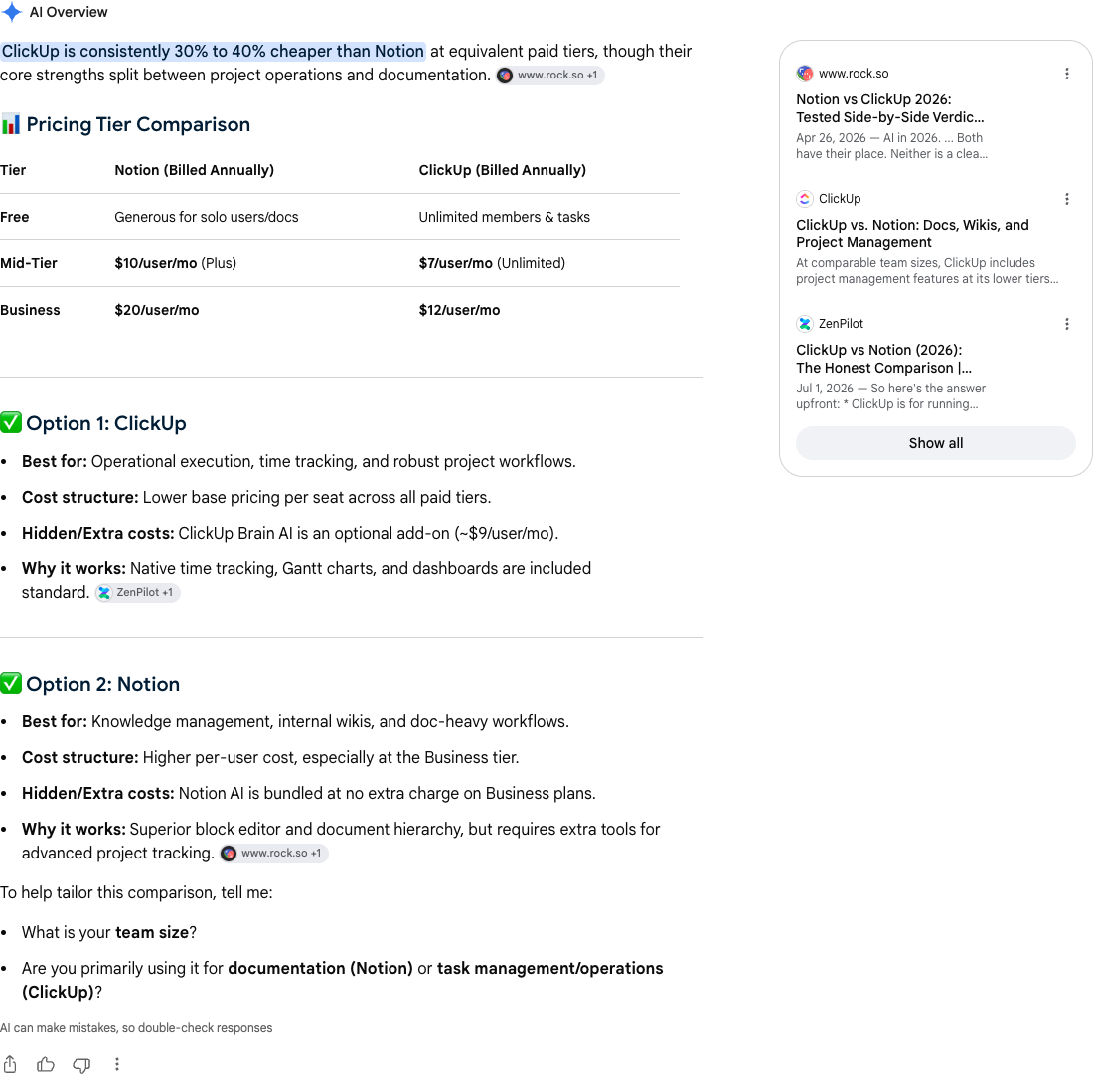
Exhibit 50. Google AI Overview for "Notion vs ClickUp pricing", United States, signed out, captured September 7, 2026, 10:06 UTC.
This one record tells the client more than a score: Notion is in the answer, a competitor's help page is one of three sources, and no Notion page is cited.
4. Report counts with their denominators and dates
"Named in 42 of 50, United States, September 7, 2026" can be checked; "84% visibility" can't. Put the count next to any percentage, and define share of voice the same way: counting each brand once per answer, the four tracked brands in the Notion sample appeared 111 times across 50 answers, 42 of them Notion (37.8%).
5. Attach the exhibit to every claim
Every count links to the screenshots it counts, and every quote comes with its picture and timestamp. The client can check any number, and the record survives a change of account lead.
6. Keep the steadier layer apart from the volatile one
Draw trend lines only for the steadier layer: AI Overviews shown, answers naming or citing the client, recurring domains. Wording, brand order and individual URLs go in as dated examples.
7. Claim a change only with a dated before and after
Show the same query, market and conditions at two dates, screenshots side by side. With a 70% chance of change between observations in Ahrefs' data, one flip is expected; call it a result when it holds at the next re-check. Put what you changed, and when, next to what moved: a sequence, not proof of cause.
Nordcite can repeat the same queries on a schedule agreed in your quote and set each run beside the last, with the screenshots behind it.
How to say it to a client
Say what was seen, where, when and out of how many, and attach the picture. Leave out causes you can't show.
| Misleading | Honest |
|---|---|
| "You rank #2 in Google's AI Overviews." | "On September 7, 2026, the AI Overview for 'Notion vs ClickUp pricing' named Notion in its first sentence but cited three other sites (exhibit 50)." |
| "Your AI visibility is 84%." | "Named in 42 of our 50 agreed queries, United States, signed out, captured September 7, 2026." |
| "Google prefers YouTube in your category." | "youtube.com was cited in 36 of the 50 AI Overviews we captured on September 7, 2026." |
| "We got you into AI Overviews." | "Your pricing page was cited in [n] of 50 answers on [date], up from [n] on [date]. We updated it on [date]; we can't prove that caused the rise." |
| "You lost visibility this week." | "[n] answers stopped naming you in this week's capture. Changes like this are common between checks; we'll report it as a change if it holds next week." |
| "ChatGPT recommends you." | "ChatGPT named you in [k] of [n] runs of each prompt between [dates]. We report that separately from Google." |
A one-page monthly report template
One page, the same rows every month, each number with its denominator and date, and every exhibit one click away. Here it is filled in with the Notion sample as a first-month baseline.
| Row | What goes in it | Example: Notion, United States |
|---|---|---|
| Scope | Brand, market, engine, query-set version and size, capture window, signed out | Notion · US · Google AI Overviews · set v1, 50 queries · Sep 7, 2026, 09:47–10:07 UTC · signed out |
| AI Overviews shown | Queries with an AI Overview, out of all queries | 50 of 50 |
| Client named | Answers naming the client | 42 of 50 |
| Client cited | Answers citing a client-owned page | 7 of 50 (notion.com 6, notion.so 1) |
| Named, not cited | Named in the text, no own page among the sources | 35 of 50 |
| Competitors named | Answers naming each tracked competitor | ClickUp 26, monday.com 23, Asana 20 |
| Competitor named, client not | A tracked competitor named, the client absent | 6 of 50 (4 are comparisons between two competitors) |
| Most-cited domains | Domains by number of answers citing them | youtube.com 36, reddit.com 17, zapier.com 11, rock.so 10 |
| Changes since last report | Only with before and after exhibits, and whether each held at re-check | None claimed: first capture |
| Answers to act on | Two or three exhibits, each with a reason | Exhibit 50: a ClickUp help page among three sources on pricing. Exhibit 43: "is Notion safe and secure" sourced from Reddit and YouTube, no Notion page |
| Search Console | Generative AI impressions by page and country vs last month, plus any known data issues | From the client's Search Console |
| Other assistants | Sampled separately: named in k of n runs per prompt | Not part of this sample |
| Work done, next | Dated actions and what they target | — |
Lead with the shown, named and cited rows; most clients read no further. When most citations go to other people's pages, as here, our earned-media playbook covers the honest version of that work, and the pillar guide covers the client's own pages.
What about ChatGPT and other assistants?
Report them in their own section, as sampled frequencies such as "named in 4 of 5 runs," never added into your Google counts.
They behave differently. In SISTRIX's study, ChatGPT Search churned fastest: "74% of domains are new every week." Google's AI Mode changed 56% of its cited domains every week, though 86.5% of prompts kept "a stable core of 1–5 domains". A blended number would hide which surface moved.
Frequency holds better than order. In SparkToro's study, City of Hope appeared in 69 of 71 ChatGPT answers about West Coast cancer care hospitals (97%) but was the top mention in only 25.
To sample fairly, keep the wording fixed, use a fresh conversation with no saved memory for each run, and give every prompt the same number of runs. Five runs per prompt is a floor; 20 prompts at five runs each makes 100 runs, closer to the "dozens to hundreds" of prompts Fishkin describes. Keep AI Mode in its own section too: Search Console counts its follow-up questions as new queries.
What we don't know yet
- What Search Console will add. Google has said more metrics will come; queries, clicks or a split between AI Overviews and AI Mode would change the census layer.
- How AI position will be counted. Mueller said in September 2026 that it will evolve. Treat any AI position figure as provisional.
- How fast one client's answers move. Published churn figures are averages over large keyword sets; only repeated captures show one client's pace.
- When a change is real. "Holds at the next re-check" is our working rule, not a published standard.
- What a mention without a link is worth. The research we reviewed found no study linking a brand's place in AI Overview text to clicks or sales.
FAQ
Is an AI Overview counted as an impression in Search Console?
Yes. AI Overviews and AI Mode count within the Web search type, with every link in one AI Overview sharing a single position. The generative AI performance report counts impressions of links to your site, so a mention without a link doesn't appear.
How often do AI Overviews change?
Often in wording and links, less in meaning and cited sites. In Ahrefs' study, an AI Overview had a 70% chance of changing between observations; in SISTRIX's 17-week study, 53% of AI Overview prompts kept exactly the same cited domains.
Are AI visibility scores accurate?
Only as accurate as what's behind them: which queries, how many, where, when and what formula. Ask for the counts and the screenshots. Treated as a sample, a 20% rate over 50 queries is consistent with about 11% to 33% (our arithmetic).
How do I explain a drop to a client?
Open the before and after exhibits and check three things: whether the AI Overview disappeared, whether the client lost the name or only the link, and whether the change held at re-check. Check Google's data notes too. Google's data anomalies page records that "A logging error caused a decrease in impressions on the Generative AI performance report in Search for data from August 13 - August 17, 2026," and adds: "Missing data for this period has been restored."
Is this the same as measuring GEO?
Some call this GEO or AEO; Google's own guide calls it SEO: "From Google Search's perspective, optimizing for generative AI search is optimizing for the search experience, and thus still SEO." The reporting method is the same under any label.
Sources
- Ahrefs (Louise Linehan, Xibeijia Guan), "AI Overviews Change Every 2 Days (But Never Change Their Mind)", November 11, 2025, updated August 12, 2026. https://ahrefs.com/blog/ai-overview-change/
- SparkToro (Rand Fishkin), "NEW Research: AIs are highly inconsistent when recommending brands or products; marketers should take care when tracking AI visibility", January 27, 2026. https://sparktoro.com/blog/new-research-ais-are-highly-inconsistent-when-recommending-brands-or-products-marketers-should-take-care-when-tracking-ai-visibility/
- SISTRIX (Johannes Beus), "AI Citation drift: How stable are sources in AI search results?", May 1, 2026, modified May 12, 2026. https://www.sistrix.com/blog/ai-citation-drift-how-stable-are-sources-in-ai-search-results/
- Google, Search Console Help, "What are impressions, position, and clicks?" (sections "AI Overviews" and "AI Mode"), accessed September 18, 2026. https://support.google.com/webmasters/answer/7042828
- Google, Search Console Help, "Generative AI performance report (Search)", accessed September 18, 2026. https://support.google.com/webmasters/answer/16984139
- Google Search Central, "Optimizing your website for generative AI features on Google Search", last updated July 10, 2026. https://developers.google.com/search/docs/fundamentals/ai-optimization-guide
- Search Engine Roundtable (Barry Schwartz), "Google: Google Search Console AI Position Reporting Will Evolve Over Time", September 16, 2026. https://www.seroundtable.com/google-search-console-ai-reporting-change-42099.html
- Search Engine Land (Barry Schwartz), "Google Search Console AI performance reports and controls to block your content in AI responses", June 3, 2026. https://searchengineland.com/google-search-console-ai-performance-reports-and-controls-to-block-your-content-in-ai-responses-479298
- Google, Search Console Help, "Data anomalies in Search Console", accessed September 18, 2026. https://support.google.com/webmasters/answer/6211453
- Temso (David Gregorian), "Your SaaS Authority Ends at the Border: How AI Citations Change by Country", last updated April 13, 2026. https://www.temso.ai/data/Your-SaaS-authority-ends-at-the-border
- Nordcite, Notion sample: 50 Google AI Overviews, United States, signed out, captured September 7, 2026. /blog/notion-ai-overviews-citations
See what Google's AI Overview says about your brand, in the country you sell in. Nordcite's AI Visibility Report runs a query set written for your brand in the markets you choose and photographs every AI Overview: who is named, which sources are cited, dated. A person approves your queries before anything runs and reads the report before it ships. Each report is scoped and quoted for the brand it describes. See a sample report · Ask for a quote
Read next
- Search Console's generative AI report: what it shows, and what it can't
Google's generative AI performance report went global on Aug 31, 2026. It counts link impressions by page, country and date. Here's what it leaves out.
- We photographed 50 Google AI Overviews about Notion. Here's who got cited.
50 Google AI Overviews about Notion, captured in the US on Sep 7, 2026: YouTube cited in 36, Reddit in 17, notion.com in 6. 110 domains, 83 cited once.
- How to get cited in Google's AI Overviews: what the evidence says in 2026
What gets a brand named and cited in Google's AI Overviews and AI Mode: Google's own guidance, the studies worth trusting, and 50 dated screenshots.
- Earned media for AI citations: how to get into the sources Google already cites (without astroturfing)
In 50 AI Overviews about Notion (Sep 7, 2026), YouTube was cited in 36 and notion.com in 6. How to earn honest mentions, and why fake posts backfire.